
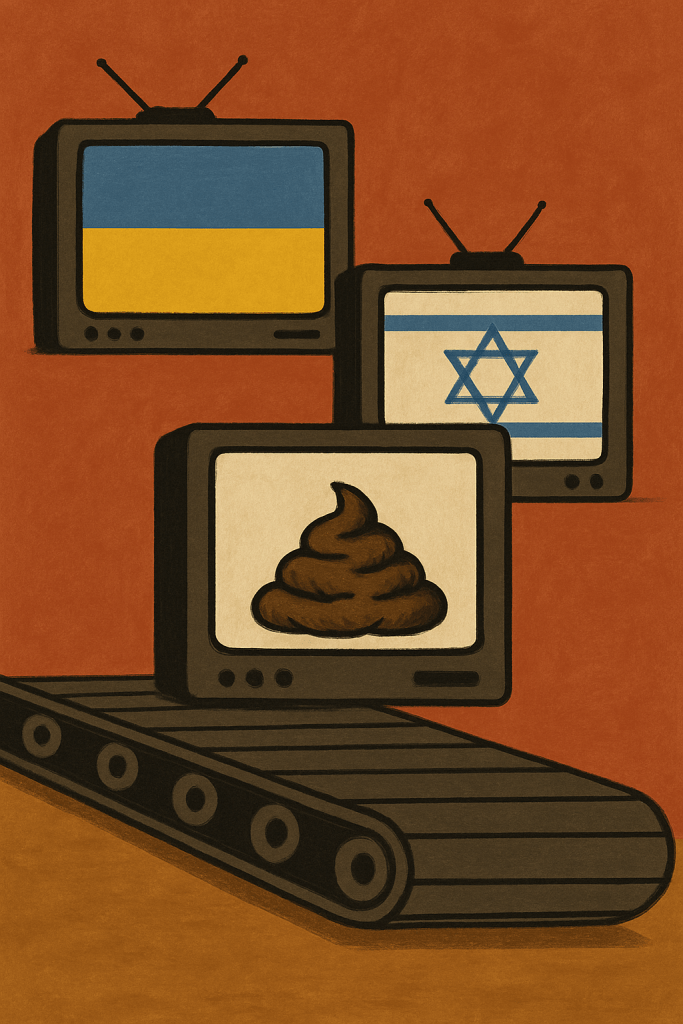
TELLY‑VISION OF WAR

You ever notice how every war comes with its own advertising campaign? They don’t just drop bombs anymore, they drop slogans. Russia and Ukraine? That’s the “freedom and democracy” brand. Israel and Palestine? That’s the “complicated family dispute” brand. Same blood, same rubble, but two completely different commercials.

And the media — oh, the media. These people don’t report the news, they sell it. They package it like laundry detergent: “New and improved conflict in Eastern Europe! Now with 30% more moral clarity!” When Russia invaded Ukraine, the whole news machine snapped into action like a Broadway musical. Somber music, maps with arrows, anchors with serious voices. “This is an attack on freedom itself.” Freedom itself! Sounds big, doesn’t it? Sounds like they’re defending truth, justice, and the American way. Which is funny, because the American way has usually meant bombing the shit out of someone who can’t fight back.

And suddenly, everybody’s a Ukraine expert. People who couldn’t find Kiev on a map if it was tattooed on their ass are posting hashtags, waving little flags, changing their profile pictures. McDonald’s pulls out of Russia. Coca‑Cola makes a statement. Starbucks issues solidarity. You know a war is real when the people who sell sugar water and fries get involved. “You may be starving in a bunker, but at least we stand with you — limited time only!”

Now flip the channel. Israel and Palestine. Oh boy. Whole different script. Same bombs, same dead kids, same smoke in the air, but the coverage? Suddenly it’s like you walked in on a family argument you weren’t invited to. The anchors lean in: “Well, it’s complicated.” You ever notice how “it’s complicated” is just adult code for “We don’t want to lose our advertisers”?

Because here’s the deal: Russia is an easy villain. Putin is the perfect bad guy. He’s got the scowl, the shirtless horseback photos, the whole Bond villain starter kit. Perfect casting. Israel and Palestine? That’s messy. That’s history, religion, politics, money, land, blood, and guilt all tied into one giant ball of “don’t touch that if you want to keep your job.” So instead, the media becomes contortionists: “Both sides… cycle of violence… shades of gray.” Shades of gray? Folks, I don’t need fifty shades of gray. I need you to stop bombing hospitals and schools.

And don’t think for one second the media doesn’t love war. War is their Super Bowl. War is ratings. War gives them the chance to look serious while cashing checks. They’ve got correspondents in flak jackets standing fifty miles from the action just to say, “As you can see behind me…” No, I can’t see behind you. I see a brick wall and some smoke in the distance. You’re safer than I am in my living room, asshole.

Meanwhile, the talking heads sit in their studios with touch screens and charts, pointing at arrows like they’re ESPN analysts: “And if you look here, the Russians have advanced from the east, and if you look here, the Palestinians have advanced their desperation.” It’s not news, it’s a video game. They’re narrating body counts like it’s Monday Night Football. “And that makes 25 civilian deaths today — back to you, Tom!”

And here’s the callback, folks: the Ukraine war got a branding kit. Blue and yellow filters, celebrity fundraisers, heartfelt speeches. It had marketing value. Israel and Palestine? That one doesn’t get the package deal. That one’s “complicated.” You can’t slap a “Stand with Gaza” frappuccino on the Starbucks menu without losing half your customers. You can’t make a “Peace in the Middle East” Happy Meal without getting angry letters from both sides.

Because let’s face it: the only thing that matters to the media, the politicians, and the corporations — is comfort. Who’s comfortable crying for whom? Who’s comfortable buying a T‑shirt, a flag, or a latte? They’ll let you have outrage, sure — but only the kind they can monetize.

So don’t be fooled. All these wars, all these conflicts, it’s the same damn play. Money, land, power, and whose God has the bigger dick. That’s it. Same script, different actors. And the media? They’re the hype men. They don’t care who dies, as long as the ratings live.

And you know what the real punchline is? The war doesn’t end when the bombs stop. The war ends when the advertisers get bored. That’s when they move on to the next tragedy, the next “special report,” the next human suffering package they can sell you in 30‑second intervals between soap and soda commercials.

So remember, folks: when you’re watching the news and you see bombs falling and anchors crying, just ask yourself — what’s the slogan for this war? Because there’s always a slogan. And behind that slogan is a network, a sponsor, and a bunch of executives who are praying — not for peace, but for good ratings

Pack of wolves

Any typical school kid from India must have learnt about Ashoka – The Great. He once ruled the entire Indian subcontinent. What we were thought in school was that he was a great king, he got trees planted along the side of the road to make travel easy. It may not be the most important thing he did in his life but again I did not write my text books. The symbol of a 24 spoke wheel on Indian flag is his legacy being celebrated. But he wasn’t always great, in fact he started out a terrible ruler and only changed after the battle of Kalinga. He self reflected and had a realization after massacring thousands of people. He did not completely cut out violence after that but he became a far better person. If he were living in this day and age, #AskohaTheTerrible would have been trending after his first war. I am actually waiting for some descendant of the people he killed to start an online petition to remove the Chakra from the Indian flag.

In the movie Munnabhai MBBS, there is a scene where a pick pocket tries to pinch the wallet of an elderly person. Get gets caught in the act and immediately the people in the vicinity transform into a lync mob and start trashing the wanna be thief. The elderly man intervenes and asks the thief if he wishes to be left at the mercy of the angry mob. He goes on “These are the citizens of our country. See the anger in their eyes? One just had a fight with his wife, someone’s son isn’t heeding his words, another is jealous of their neighbor and someone got a scolding from their landlord in the morning. They never speak up there, because they lack the courage. They will show all their anger on you.” Even though the move came out in 2003, it was right on point about the general outrage not just in India but around the world. In a way that scene was written well ahead of its time.

“There are no weeds, and no worthless men. There are only bad farmers.”

Victor Hugo, Les Misérables

Victor Hugo, in Les Miserables, says that there are no worthless people, they are like that because of their upbringing. I do not agree completely to the statement. I understand the premise, but I feel that there is a point in every ones life when they are a weed. But most people in normal circumstances, get out of this phase and do make something better of themselves. At least they try. The ones that do not try, even if the conditions are favorable are really worthless. There is a difference between a person who sends you an email that he is a Nigerian Price who can send you his fortune if you pay the customs fee and Lehman brothers. There is a difference between a guy who ogles women in a bus stop and someone like Harvey Weinstein. The former are either victims of circumstance or still in that stupid phase. The latter are the worthless people. If Hugo was alive, he would definitely call them the result of bad farmers.

But, just like the people who tried to trash the pickpocket in the movie, the people now a days are finding it difficult, in fact even more difficult to distinguish between the two. The social media, especially twitter is full of people who, like a pack of wolves waiting to pounce on any and every mistake made. I have been hearing about the numerous lives destroyed for something someone did or said decades ago. Last year, a top executive in Boeing had to leave the company for an article he wrote 29 years earlier that argued women shouldn’t be in the defense forces. There is a separate pack on stand by to attack people on separate issues, ideologies. When the liberals do it, the conservatives call it Cancel culture, but when they do it they refer it to as protecting the moral standard of the society.

Be honest and name an Ideal person. A person who never did any mistake in their life? Aren’t you yourself embarrassed if not ashamed by things you did or said? I am. I have many instances of things that I did that I was not particularly proud of . I am sure many of the poor souls who got kicked out of their jobs because of the cancel culture are too. Most Indians would name Mahatma Gandhi, the father of the nation as an example of an Ideal person. But he too did not stand against racial injustice as soon as he saw it. He did not change until things got personal and he was kicked out of a 1st class carriage on a train in South Africa. Speaking of South Africa, Nelson Mandela’s first wife accused him of beating and being threatened with an axe.

The public shaming has now gone on to such ridiculous lengths that one mistake in judgement can end your life as you know it. It doesn’t matter if its a simple joke between friends, or even if the so called victim the twitterati imagined was not even offended by the action. It doesn’t matter if the matter is stupid and personal or even purely accidental. The world is a complex and messed up place. You cannot apply the same medicine to every disease, each and every one of the have to be looked objectively. If one feels outraged or angry at someone, take a moment pause and think about if what they did was just stupid or unintentional. Check if you are really looking at a weed or if its a plant that needs to be forgiven for one mistake. May be sometimes they were speakeing the truth and you just didn’t like it.

It is necessary to take out the weeds but it is also important not to take an axe to every tree with a crooked branch. If we do that, we may end up in a world with no trees. Our society as a whole is becoming too politically correct for its own well being. There is a saying in India that a person with Jaundice sees the entire world as green, which is equivalent to seeing the world with ‘Tinted’ glasses. They also say a picture is worth a 1000 words, not sure how much a video is worth (24 frames*number of seconds*1000?)