
The Chinese whisper with Google translate

Imagine playing Chinese whispers but where each player speaks a different language.
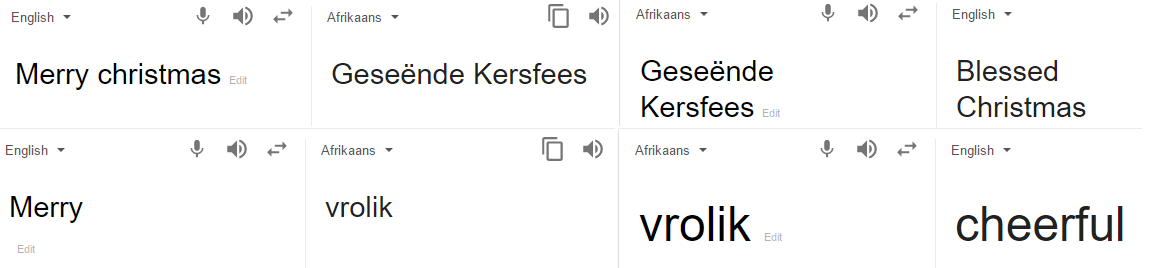
I’ve given you on my take of the science of linguistics and yet haven’t arrived at the point. I’m getting to it. My point is very simple and you will understand the reason I gave you a linguistic lecture when I get to it.
Heinrich Himmler was a prominent member of Nazi party of Germany. He was one of the architects of Holocaust. He was also obsessed with India and Hinduism. Himmler had a keen interest in the Rigveda and the Bhagavad Gita. Himmler carried a copy of the Bhagavad Gita in his pocket from 1941 until his death four years later. The book was a translation by the German theosophist, Dr. Franz Hartmann. In 1844, the German philosopher Friedrich Wilhelm Joseph Schelling highlighted in his lectures the same passage from the fourth chapter of the Bhagavad Gita, which 100 years later would fascinate Himmler – so much so that he dictated this passage to his massage therapist. This passage emphasises that a person’s identity does not have to be defined by one’s actions — that is, even if they commit evil acts, they can still remain untainted and unaffected by ones’ own actions. Talk about taking things out of context.
Texts written in Devanagari and Bramhi scripts, translated by a German, for a German and then used to justify their actions. Great. Then there is the Aryan Invasion theory. Nazi’s thought that Indians are descendants of Aryans, who were early Germans that migrated and invaded the Indian subcontinent. A theory that has been proved wrong using DNA tests.
Let me quote an example of how Sanskrit can be interpreted in multiple ways…
keśavaṃ patitaṃ dṛṣṭvā
pāṇḍavāḥ harṣanirbharāḥ |
rudanti kauravāḥ sarve
hā hā keśava keśava ||
(Seeing the fall of Krishna,
The Pandavas jumped with joy.
All the Kauravas cried aloud,
“Oh! Oh! Krishna! Krishna!”)
Clearly, there is something amiss here. The Pandavas are such dear friends and admirers of Krishna that they would obviously not rejoice in his fall. The Kauravas so hate Krishna that they would surely not wail at his collapse. The real meaning of this kind of trick verse is often understood by splitting the words in a way that is not readily evident.
The word keśavaṃ (Keshava is another name for Krishna; Keshava means “the lord of creation, sustenance, and dissolution”) can be split into ke śavaṃ (ke = in the water; śavaṃ = corpse). The word pāṇḍavāḥ (Pandavas are sons of King Pandu) can be split into pā aṇḍavāḥ (pā = water; aṇḍavāḥ = born from eggs). The word kauravāḥ (Kauravas are descendents of King Kuru) can be split into kau ravāḥ (kau = who; ravāḥ = noise, howl).
Now, with the word-splits, we get the revised meaning:
Seeing a corpse fall into the water,
The fish jumped with joy.
All the howlers cried aloud,
“Oh! Oh! A corpse in the water! A corpse in the water!”
(Here, “born from eggs” refers to fish while “one who howls” could refer to the wolves or other wild animals who can’t access the meat; or it could refer to the crows cawing loudly).
If one verse can be misinterpreted in such a different way, imagine what can be done to 700 verses. Then they took the ancient symbol used to denote well being. Turned it into and made it a house hold name of anti-Semitism, genocide, war and destruction.
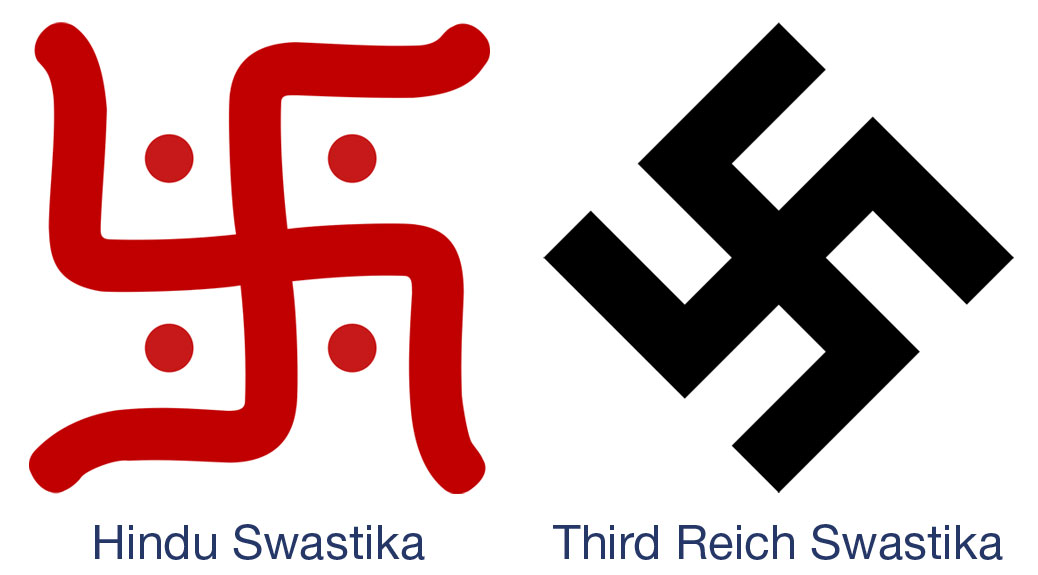
This symbol has a great prominence in Indian culture. Its as important to Indians as a cross is to Christians. Even to this day, when Indian’s buy a new house or a vehicle, we put the symbol on it. Imagine an Indian buying a car in Europe and putting the swastika on it. At the very least, his neighbours will call the cops. The worst case scenario is that secret service will take him in for interrogation. All because… things were lost in translation.
In Mein Kampf, and also Third reich literature the symbol was called HakenKreuz. A HakenKreuz literally means Hooked cross in English. But when James Murphy, an English Christian Priest translated Mein Lampf, he conveniently used the word Swastika. By the standards of James Murphy, “Fledermaus” becomes “Fled he mouse” or “Fleder mouse”. By the way Fledermaus is a Bat. Not a sports bat, but the bat in Batman. Sure it does look like a mouse with wings but its no reason to call it a mouse. That’s ignorance. But Mr. James was anything but ignorant.Just because he wanted people to forget centuries persecution of Jews by Christians. Cross reminds everyone of Christians. Nazi’s were not the first ones to hate Jews. Jews are termed God Killers by the new testament.

Above is the so called Swastika in Lambach Abbey Christian monastery. You can call it a swastika if and only if Austrian Christians adopted Hinduism in 11th Century. That didn’t happen, so its actually Christian symbol. Mr. James’s translation was an intentional mistake. But still its a mistake in translation.
What if something similar happened to the western world. How would they take it? What if someone took a cross, put it on a flag, kill 100 times as many people as the Vietnam War? Oops. This already happened and there is a name to it as well. I just described the crusades. Still, you can buy a Jerusalem cross pendent and wear it around your neck and go out. No one will give you a second glance.
Apparently some things are lost in translation and some things are some other things are polluted in the name of translation.
World history comes with a ‘Conditions apply!!’ disclaimer.
 Random thoughts of a confused primate